

- What Is Appliance Earthing?
- Why Is Earthing Important?
- What Is a Class I Appliance?
- What Does an Electrical Safety Check Look At?
- How Is Appliance Earthing Checked?
- What If an Appliance Has No Earth Connection?
- What If the Earth Connection Is Faulty?
- Appliance Earthing and Gas Appliances
- Appliance Earthing and Victorian Rental Properties
- What About AS/NZS 3019?
- How Often Does a Victorian Rental Need an Electrical Safety Check?
- What Should Landlords Do If They Are Concerned About Appliance Earthing?
- Why Regular Electrical Safety Checks Matter
- Need an Electrical Safety Check for Your Rental Property?
Appliance Earthing: What Victorian Landlords Need to Know
Electrical safety is an important responsibility for Victorian rental providers. One of the areas assessed during an electrical safety check is the condition and safety of the property’s electrical installations, fixtures and fittings.
Appliance earthing is an important part of electrical safety because exposed conductive parts of certain electrical appliances need appropriate protection against electric shock.
For landlords and property managers, understanding the basics of appliance earthing can help explain why electrical safety checks are important and why potentially faulty electrical equipment should be assessed by a licensed electrician.
What Is Appliance Earthing? #
Earthing is a safety measure designed to help protect people from electric shock if an electrical fault causes exposed conductive parts of equipment to become energised.
For an appliance that requires protective earthing, the earthing system provides a path for fault current so that protective devices can operate and disconnect the supply.
This is particularly relevant to Class I electrical equipment, which relies on protective earthing as part of its safety system.
Why Is Earthing Important? #
If a fault occurs inside an electrical appliance, accessible metal parts could potentially become electrically live if the protective earthing system is not functioning correctly.
A properly functioning protective earthing arrangement helps reduce this risk.
Problems can arise from:
- Damaged wiring
- Faulty connections
- Deteriorated electrical equipment
- Damaged cords or plugs
- Poor repairs or modifications
- Faulty earthing connections
- Corrosion or deterioration
- Previous electrical work that was not completed correctly
These issues may not always be visible to a landlord or renter.
This is one reason electrical safety checks should be carried out by an appropriately licensed or registered electrician.
What Is a Class I Appliance? #
Electrical equipment is classified according to how it protects users against electric shock.
A Class I appliance relies on basic insulation together with protective earthing.
Examples can include certain fixed wired appliances and other equipment with exposed conductive parts that require an earth connection.
A licensed electrician can determine the classification and appropriate safety requirements for a particular appliance.
What Does an Electrical Safety Check Look At? #
Victorian rental electrical safety checks are not limited to checking whether the lights and power points appear to work.
Consumer Affairs Victoria states that the electrical safety check must cover all electrical installations, fixtures and fittings and be carried out in accordance with section 4 of AS/NZS 3019 – Electrical installations – Periodic assessment.
Energy Safe Victoria also identifies AS/NZS 3019:2022 as the current Standard used for the inspection and testing requirements.
Depending on the installation and the circumstances of the inspection, the electrician may assess matters including:
- Protective earthing
- Electrical connections
- Switches and outlets
- Fixed electrical equipment
- Accessible wiring
- Signs of damage or deterioration
- Safety switches and circuit protection
- Other electrical installation safety issues
The inspection is intended to identify electrical safety issues and determine whether further investigation or repair is required.
How Is Appliance Earthing Checked? #
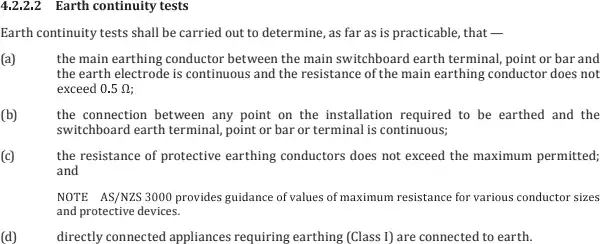
An electrician can use appropriate inspection and testing methods to assess the protective earthing arrangements of electrical equipment and the installation.
The assessment may include checking whether:
- Equipment requiring earthing is appropriately connected
- The earth continuity is satisfactory
- Protective earthing conductors are in suitable condition
- Connections appear secure
- There are signs of damage or deterioration
- Electrical equipment has been altered or modified
- Further testing is necessary
The extent of inspection and testing depends on the installation and the circumstances identified during the assessment.
A landlord should never attempt to test or repair an electrical earth connection themselves.
What If an Appliance Has No Earth Connection? #
Not every electrical appliance is required to have a separate earth connection.
Some appliances are designed as Class II equipment, which uses double or reinforced insulation rather than protective earthing.
For this reason, seeing a two-pin plug or an appliance without an earth connection does not automatically mean the appliance is unsafe.
The electrician needs to determine the type of equipment and whether its construction and installation are appropriate.
What If the Earth Connection Is Faulty? #
A faulty protective earth connection can present a serious electrical safety risk.
If an electrical safety check identifies a problem, the electrician may recommend repair, replacement or further investigation.
Depending on the nature of the fault, the affected equipment or circuit may need to be isolated until it can be made safe.
Landlords should not attempt to bypass an electrical fault or make temporary modifications to an earth connection.
Electrical work must be carried out by an appropriately licensed electrical professional.
Appliance Earthing and Gas Appliances #
Some gas appliances also have electrical components or electrical connections.
For example, a gas appliance may use electricity for:
- Ignition
- Controls
- Fans
- Electronic components
- Other operating functions
The presence of a gas appliance does not make appliance earthing a gas-only issue.
Where electrical safety is concerned, the electrical installation and equipment should be assessed by an appropriately licensed electrician.
This is separate from the gas safety check performed by an appropriately qualified gasfitter.
Appliance Earthing and Victorian Rental Properties #
Victorian rental providers have specific electrical safety responsibilities.
Consumer Affairs Victoria states that rental providers entering into applicable rental agreements after 29 March 2021 must have electrical installations and fittings checked by a licensed electrician at least once every two years.
The electrical safety check must cover all electrical installations, fixtures and fittings in accordance with section 4 of AS/NZS 3019.
The electrician must provide a record of the check, including details such as the electrician’s name and licence or registration number, the date of the inspection, results and any repairs or actions required.
What About AS/NZS 3019? #
The Detector Inspector article refers to AS/NZS 3019:2007, but the current Victorian rental electrical safety framework refers to AS/NZS 3019:2022 – Electrical installations – Periodic assessment.
Energy Safe Victoria states that the inspection and testing for Victorian rental electrical safety checks must be conducted to the requirements of section 4 of AS/NZS 3019:2022.
This is an important distinction for landlords and property managers researching older information online.
Rather than relying on an older extract from AS/NZS 3019:2007, property owners should use the current Victorian requirements and have the electrical installation assessed by a licensed or registered electrician.
How Often Does a Victorian Rental Need an Electrical Safety Check? #
For applicable Victorian rental agreements, electrical safety checks are required every two years.
Consumer Affairs Victoria also states that if an electrical safety check has not been completed within the previous two years when a renter moves into the property, the rental provider must arrange a check as soon as possible.
From 13 October 2026, mandatory gas and electrical safety checks every two years will apply to all Victorian rental agreements, including agreements that began before the previous requirements took effect.
Landlords and property managers should keep records of their completed electrical safety checks.
What Should Landlords Do If They Are Concerned About Appliance Earthing? #
If you are concerned about the earthing of an appliance or electrical installation:
- Do not attempt to test or repair the earth connection yourself.
- Arrange an electrical safety inspection with a licensed or registered electrician.
- Tell the electrician about any known electrical faults or previous modifications.
- Have any identified safety issues professionally assessed.
- Arrange repairs or replacement where recommended.
- Keep the electrical safety check report with your rental property records.
If an appliance is damaged, gives an electric shock or causes a safety switch to trip repeatedly, stop using it and arrange professional assessment.
Why Regular Electrical Safety Checks Matter #
Electrical faults can be difficult to identify without appropriate testing.
A property may have functioning lights and power points while still having electrical safety issues that require professional attention.
Regular electrical safety checks help landlords and property managers identify potential problems involving electrical installations, fittings and equipment.
A professional inspection can provide a clearer picture of the condition of the property’s electrical installation and identify work that may be required.
Need an Electrical Safety Check for Your Rental Property? #
At Rental Safety Inspections, we help Victorian landlords and property managers stay on top of their rental property safety responsibilities.
Our electrical safety inspections can help identify potential issues with electrical installations, fixtures, fittings and protective safety measures.
If your rental property is due for its two-year electrical safety check, or you are concerned about appliance earthing or another electrical safety issue, arrange an inspection with a qualified electrical professional.
Keep your rental property safe, maintained and ready for your tenants.


