
- What Is a Main Switch?
- What Is a Main Isolator?
- Why Is Identification Important?
- What Should Main Switch Labelling Tell You?
- What If the Main Switch Is Not Clearly Labelled?
- Main Switches and Multiple Power Supplies
- Solar Panels and Main Switch Labelling
- What About Battery Storage?
- What Does a Victorian Rental Electrical Safety Check Cover?
- Is Main Switch Labelling Part of the Electrical Safety Assessment?
- What About Older Rental Properties?
- Can a Landlord Replace the Label?
- What If a Main Switch Cannot Be Identified?
- Why Is Switchboard Identification Important for Tenants?
- How Often Does a Victorian Rental Need an Electrical Safety Check?
- What Should Landlords Do About Main Switch Labelling?
- Need an Electrical Safety Check?
Clear identification at an electrical switchboard is an important part of electrical safety.
Main switches and main isolators allow electrical supplies to be switched off when maintenance, repairs or emergency work is required. If switches are not clearly identified, it may be difficult to determine which control needs to be operated.
For Victorian landlords and property managers, main switch and main isolator labelling is therefore an important detail to consider when maintaining a rental property’s electrical installation.
What Is a Main Switch? #
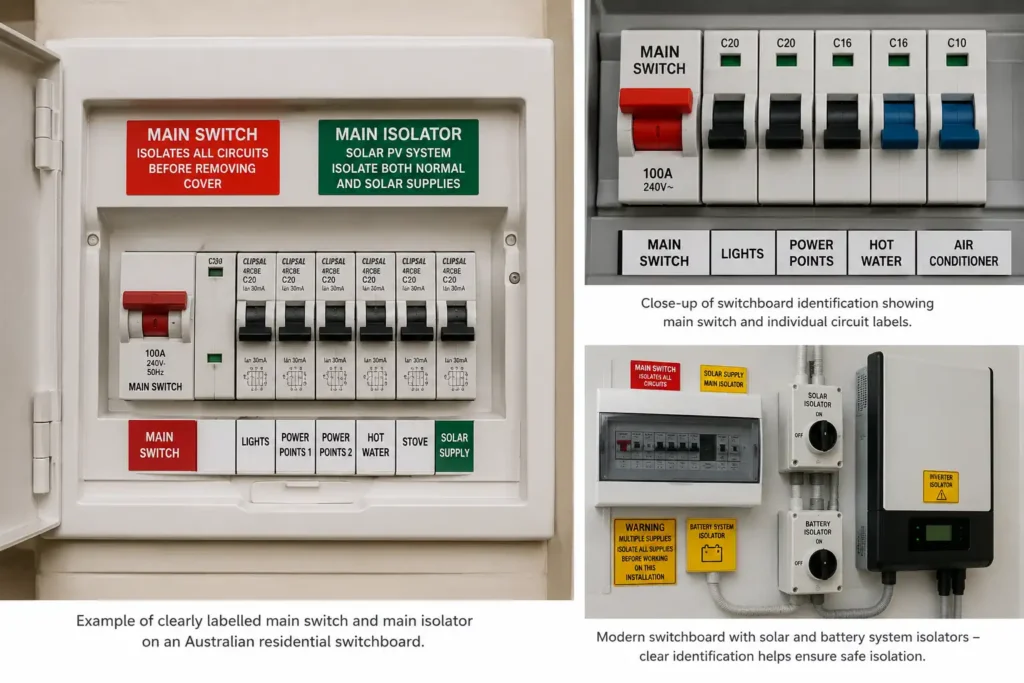
A main switch is a device used to control the supply of electricity to an installation or part of an installation.
Depending on the switchboard arrangement, there may be more than one switch or isolation point.
The purpose and arrangement of switches can vary between properties, particularly in older installations or properties that have been altered or upgraded over time.
What Is a Main Isolator? #
An isolator is a device intended to disconnect an electrical supply so that equipment or an installation can be safely isolated.
Main isolators can be particularly important during electrical work, maintenance or an emergency.
The exact switchboard arrangement depends on the electrical installation.
Why Is Identification Important? #
Imagine there is an electrical fault or an emergency at a rental property.
A person needs to be able to identify the appropriate switch quickly.
Clear labelling can help:
- Identify the main switch or isolator
- Determine which supply a switch controls
- Reduce confusion during an emergency
- Assist electricians during maintenance
- Make the switchboard easier to understand
- Improve the overall safety of the electrical installation
A switchboard that is clearly labelled is easier for occupants and electrical professionals to navigate.
What Should Main Switch Labelling Tell You? #
The identification provided at a switchboard should make it reasonably clear what the relevant switch or isolator controls.
The exact labelling arrangement can depend on the type and configuration of the electrical installation.
A licensed electrician can assess whether the identification is appropriate for the particular switchboard.
This is especially important where a property has:
- Multiple switchboards
- Multiple supplies
- Solar power
- Battery storage
- Generator connections
- Multiple dwellings
- Common areas
- Additional buildings
- Older electrical equipment
- Previous electrical modifications
What If the Main Switch Is Not Clearly Labelled? #
A switchboard with unclear or missing identification should be professionally assessed.
The problem may be as simple as a missing or deteriorated label, but the electrician may also identify other issues with the switchboard that need attention.
Do not guess which switch controls the property.
If there is an emergency or electrical fault, use the appropriate emergency procedures and contact a qualified electrical professional where required.
Main Switches and Multiple Power Supplies #
Modern properties can have more than one source or form of electrical supply.
For example, a property may have:
- Grid electricity
- Solar photovoltaic systems
- Battery energy storage
- Backup generation
- Multiple electrical supplies
- Separate switchboards
These systems can make identification and isolation particularly important.
A property owner should not assume that switching off one main switch necessarily makes every part of an electrical installation safe.
Where multiple supplies are present, appropriate isolation and warning identification should be determined by a licensed electrician.
Solar Panels and Main Switch Labelling #
Solar installations can introduce additional electrical hazards and isolation requirements.
Turning off the property’s main switch does not necessarily mean that the solar panels are no longer generating electricity.
Solar PV systems have their own equipment and isolation arrangements.
If a rental property has solar panels, the switchboard and associated equipment should be assessed by an appropriately licensed electrician to ensure the relevant isolation points and identification are appropriate.
What About Battery Storage? #
Battery energy storage systems can also introduce additional isolation and identification considerations.
A property with battery storage may have several electrical components and isolation points.
Landlords should not attempt to modify labels, isolate equipment or work on the system themselves.
If you are unsure what a switch controls, contact a licensed electrician.
What Does a Victorian Rental Electrical Safety Check Cover? #
Victorian rental providers have electrical safety obligations.
Consumer Affairs Victoria states that applicable rental properties must have their electrical installations, fixtures and fittings checked at least every two years by a licensed electrician. The electrical safety check must cover all electrical installations, fixtures and fittings in accordance with section 4 of AS/NZS 3019 – Electrical installations – Periodic assessment. Consumer Affairs Victoria – Rental provider gas and electrical safety
An electrical safety inspection is more than simply checking whether the lights and power points work.
The electrician can identify electrical safety issues that may not be obvious to a landlord or tenant.
Is Main Switch Labelling Part of the Electrical Safety Assessment? #
The electrical safety assessment considers the property’s electrical installations, fixtures and fittings and the requirements applicable to the inspection.
The electrician can assess the switchboard and its identification as part of the overall electrical safety inspection.
If labelling is missing, unclear, damaged or otherwise inadequate, the electrician can advise whether corrective work is required.
The exact requirements depend on the switchboard and installation.
What About Older Rental Properties? #
Older rental properties can have electrical installations that were constructed or modified under earlier requirements.
This is why it is important not to assume that every existing switchboard should be assessed solely by applying the newest requirements retrospectively.
The electrician should consider the requirements applicable to the installation and any relevant work or alterations carried out over time.
Where an installation has been modified, upgraded or extended, different requirements may apply to the relevant work.
Can a Landlord Replace the Label? #
A landlord should not carry out electrical work themselves.
While replacing a simple label might appear straightforward, the correct identification needs to correspond with the actual electrical installation.
If you are unsure about a switchboard label, have a licensed electrician inspect the installation and determine what identification is required.
This is particularly important where there are multiple supplies, solar panels, batteries or other electrical systems.
What If a Main Switch Cannot Be Identified? #
If the main switch or isolator cannot be clearly identified:
- Don’t guess which switch controls the installation.
- Don’t open the switchboard.
- Don’t remove electrical covers.
- Arrange an inspection by a licensed electrician.
- Have the switchboard and identification assessed.
- Keep records of any electrical work completed.
A qualified electrician can determine the appropriate identification for the particular installation.
Why Is Switchboard Identification Important for Tenants? #
Landlords and property managers should consider whether a tenant could understand the basic identification provided at the switchboard.
In an emergency, confusion can create additional risks.
Clear labels can help occupants identify relevant switches and can also assist emergency responders and electrical professionals.
However, tenants should never attempt to carry out electrical repairs or work inside a switchboard.
How Often Does a Victorian Rental Need an Electrical Safety Check? #
For applicable Victorian rental agreements, electrical safety checks are required every two years.
Consumer Affairs Victoria requires the check to be completed by a licensed electrician and records of the inspection must be provided and retained as required. Consumer Affairs Victoria – Rental provider gas and electrical safety
From 13 October 2026, mandatory gas and electrical safety checks every two years will apply to all Victorian rental agreements, including agreements that commenced before the previous requirements took effect. Consumer Affairs Victoria – New rental law changes
Landlords and property managers should keep their electrical inspection records up to date.
What Should Landlords Do About Main Switch Labelling? #
If you manage a Victorian rental property, consider the following:
- Check that the switchboard is accessible.
- Look for clear identification of relevant switches.
- Don’t attempt to open or modify the switchboard.
- Arrange professional assessment if labels are missing or unclear.
- Tell the electrician about solar, batteries or other additional supplies.
- Keep records of electrical inspections and repairs.
A licensed electrician can determine whether the switchboard identification is suitable for the particular installation.
Need an Electrical Safety Check? #
At Rental Safety Inspections, we help Victorian landlords and property managers stay on top of their rental property safety responsibilities.
Our electrical safety inspections can help identify potential issues with electrical installations, switchboards, fixtures and fittings.
If your rental property is due for its two-year electrical safety check, or you’re concerned about main switch identification or switchboard labelling, arrange an inspection with a qualified electrical professional.
Keep your rental property’s electrical installation safe, maintained and ready for your tenants.


